
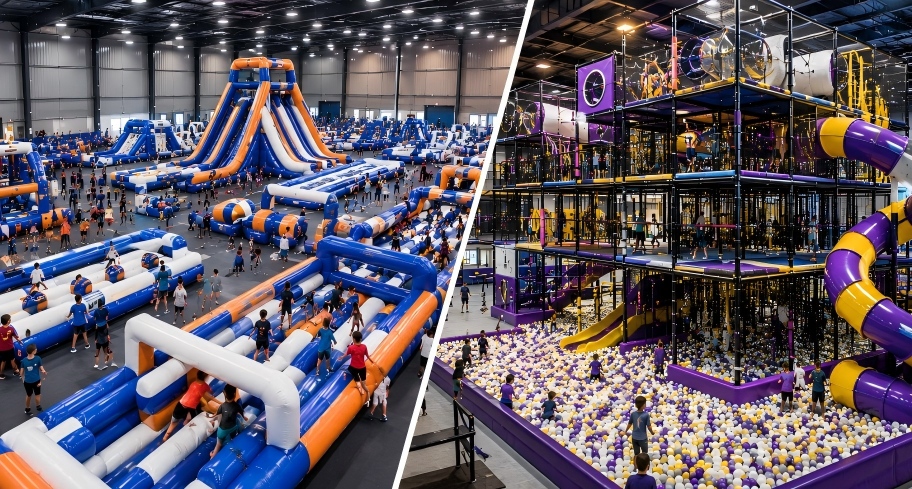
As demand for family entertainment continues to grow, more entrepreneurs across Canada are investing in indoor attractions that provide active, engaging experiences for children and families. Among the most popular options are commercial inflatable parks and indoor playgrounds.
While both business models can generate revenue through admissions, birthday parties, and group events, they differ significantly in terms of investment, maintenance, flexibility, customer demographics, and long-term profitability.
If you’re planning to open a family entertainment centre, understanding these differences will help you choose the business model that best fits your venue, budget, and long-term goals.
What Is a Commercial Inflatable Park?
A commercial inflatable park is a large-scale entertainment facility made up of interconnected inflatable attractions. Unlike a traditional bounce house, these parks are designed to accommodate many visitors at the same time while offering a variety of activities.
A commercial inflatable park may include:
- Obstacle courses
- Giant slides
- Climbing walls
- Wipeout games
- Interactive challenges
- Ninja-style courses
- Bounce zones
- Toddler play areas
Because of their modular design, inflatable parks can be customized for different venues and expanded as a business grows.
What Is an Indoor Playground?
An indoor playground is a permanent play structure built using steel frames, plastic components, tunnels, climbing nets, slides, ball pits, and padded flooring.
Indoor playgrounds are commonly installed in shopping centres, restaurants, recreation facilities, and family entertainment centres. They are primarily designed for younger children and typically remain in the same layout for many years.
Although indoor playgrounds provide excellent play value, modifying or expanding them often requires significant renovation.
Comparing the Initial Investment
For many investors, the initial budget is one of the first considerations.
Commercial Inflatable Park
A commercial inflatable park typically requires:
- Inflatable attractions
- Commercial blowers
- Safety mats
- Anchoring systems
- Basic venue preparation
Since most of the equipment is inflatable rather than permanently constructed, installation is generally faster and requires less building work.
Its modular design also allows operators to begin with a smaller layout and expand over time as customer demand increases.
Indoor Playground
Indoor playgrounds usually require:
- Permanent steel structures
- Custom fabrication
- Professional installation
- Specialized flooring
- Extensive construction work
- Longer installation periods
Because much of the equipment becomes part of the building, the initial investment is often higher.
Overall Advantage: Commercial Inflatable Park
Operating Costs
Both business models involve ongoing operating expenses, but the cost structure differs.
Commercial Inflatable Parks
Typical operating costs include:
- Electricity for blowers
- Cleaning and sanitation
- Daily inspections
- Minor PVC repairs
- Insurance
- Staff wages
Indoor Playgrounds
Typical operating costs include:
- Cleaning
- Structural inspections
- Component replacement
- Net and padding repairs
- Insurance
- Staff wages
Since inflatable attractions are modular, replacing or repairing individual sections is generally simpler and more cost-effective than repairing permanent play structures.
Overall Advantage: Commercial Inflatable Park
Visitor Experience
Customer satisfaction has a direct impact on repeat business.
Commercial inflatable parks provide exciting physical activities suitable for children, teenagers, and even adults.
Visitors can enjoy:
- Climbing challenges
- Competitive obstacle courses
- Giant inflatable slides
- Interactive games
- Team activities
The variety of attractions encourages longer visits and repeat customers.
Indoor playgrounds, by comparison, focus mainly on younger children through soft play structures, tunnels, slides, and ball pits. While these attractions remain highly popular with preschool and primary-school children, older children may lose interest more quickly.
Flexibility and Future Expansion
One of the biggest advantages of commercial inflatable parks is flexibility.
Operators can easily:
- Add new attractions
- Rearrange layouts
- Introduce seasonal themes
- Expand existing parks
- Replace individual modules
This allows businesses to refresh the customer experience without completely rebuilding the venue.
Indoor playgrounds are generally much more difficult to modify because they are permanently installed.
Overall Advantage: Commercial Inflatable Park
Maintenance Requirements
Both attractions require regular maintenance to ensure safe operation.
Commercial inflatable parks generally require:
- Daily visual inspections
- Blower maintenance
- Cleaning and sanitizing
- Minor PVC repairs
- Routine safety checks
Indoor playgrounds usually require:
- Structural inspections
- Bolt and fastener checks
- Net replacement
- Padding replacement
- Component repairs
- Surface cleaning
Neither option is maintenance-free, but inflatable equipment is typically easier and less expensive to repair because damaged sections can often be replaced individually.
Revenue Potential
The profitability of either business depends on factors such as location, attendance, pricing, and management.
However, commercial inflatable parks often offer broader revenue opportunities because they attract a wider range of customer groups.
Common revenue sources include:
- Admission tickets
- Birthday parties
- School excursions
- Corporate team-building events
- Holiday programs
- Private venue rentals
- Seasonal promotions
Because inflatable parks appeal to children, teenagers, families, schools, and corporate groups, they often have more opportunities to generate income throughout the year.
Which Option Is Better for Canadian Businesses?
Canada’s climate makes indoor entertainment an attractive business throughout much of the year.
For investors targeting:
- Family entertainment
- Birthday parties
- School programs
- Community events
- Corporate activities
a commercial inflatable park often offers greater flexibility and stronger long-term growth potential.
On the other hand, businesses that primarily serve toddlers and preschool-aged children may find that a traditional indoor playground better matches their target audience.
Ultimately, the right investment depends on your available space, customer demographics, and long-term business strategy.
Side-by-Side Comparison
| Feature | Commercial Inflatable Park | Indoor Playground |
|---|---|---|
| Initial Investment | Lower to Moderate | Moderate to High |
| Installation Time | Faster | Longer |
| Expansion | Easy | More Difficult |
| Maintenance | Relatively Simple | More Complex |
| Target Customers | Families, Schools, Events | Mainly Families with Young Children |
| ROI Potential | High | Moderate to High |
| Target Age Range | Children, Teens & Adults | Mainly Young Children |
| Layout Flexibility | Excellent | Limited |
| Seasonal Promotions | Easy | Moderate |
| Birthday Party Potential | Excellent | Excellent |
Choosing the Right Manufacturing Partner
Regardless of which entertainment concept you choose, working with an experienced manufacturer is one of the most important decisions you will make.
A professional supplier should provide:
- Commercial-grade materials
- Custom layout design
- Reinforced construction
- Safety-focused manufacturing
- Replacement parts
- Reliable after-sales support
365Inflatable Canada works with entrepreneurs, family entertainment centres, rental companies, resorts, municipalities, and event operators across Canada to design customized commercial inflatable parks that meet different venue sizes and business goals.
Whether you’re opening your first indoor attraction or expanding an existing entertainment business, choosing high-quality commercial equipment can help reduce maintenance costs, improve customer satisfaction, and support long-term growth.
Frequently Asked Questions
Is a commercial inflatable park less expensive than an indoor playground?
In many cases, yes. Because inflatable parks require less permanent construction and shorter installation times, the initial investment is often lower.
Which business is easier to expand?
Commercial inflatable parks are much easier to expand thanks to their modular design. New attractions can be added without major structural changes.
Which option attracts older children?
Commercial inflatable parks generally appeal to a wider age range, including teenagers and adults, while indoor playgrounds mainly focus on younger children.
Which business requires less maintenance?
Both require regular inspections and cleaning, but inflatable attractions are usually easier and less expensive to repair because damaged modules can often be replaced individually.
Can both attractions be combined?
Yes. Many successful family entertainment centres combine a commercial inflatable park with a dedicated toddler or soft play area to appeal to a broader customer base.
Conclusion
Both commercial inflatable parks and indoor playgrounds can become successful family entertainment businesses, but they serve different markets and investment goals.
Indoor playgrounds are an excellent choice for venues that primarily cater to younger children and prefer permanent play structures. Commercial inflatable parks, on the other hand, offer greater flexibility, faster installation, easier expansion, and attractions that appeal to a wider range of visitors.
Before making your investment decision, carefully evaluate your available space, target customers, budget, and long-term business objectives.
If you’re considering launching a commercial inflatable park in Canada, 365Inflatable Canada can help you develop a customized solution tailored to your venue, investment plan, and business goals. With professional design support, commercial-grade manufacturing, and reliable after-sales service, we are committed to helping businesses build safe, durable, and profitable inflatable park projects.